Advertisement

Viser innlegg med etiketten ml. Vis alle innlegg

søndag 11. desember 2016

The Deception of Supervised Learning

Do models or offline datasets ever really tell us what to do? Most application of supervised learning is predicated on this deception.
Imagine you're a doctor tasked with choosing a cancer therapy. Or a Netflix exec tasked with recommending movies. You have a choice. You could think hard about the problem and come up with some rules. But these rules would be overly simplistic, not personalized to the patient or customer. Alternatively, you could let the data decide what to do!
The ability to programmatically make intelligent decisions by learning complex decision rules from big data is a primary selling point of machine learning. Leaps forward in the predictive accuracy of supervised learning techniques, especially deep learning, now yield classifiers that outperform human predictive accuracy on many tasks. We can guess how an individual will rate a movie, classify images, or recognize speech with jaw-dropping accuracy. So why not make our services smart by letting the data tell us what to do?
Here's the rub.
While the supervised paradigm is but one of several in the machine learning canon, nearly all machine learning deployed in the real world amounts to supervised learning. And supervised learning methods doesn't tell us to doanything. That is, the theory and conception of supervised learning addresses pattern recognition but disregards the notion of interaction with an environment altogether.
[Quick crash course: in supervised learning, we collect a dataset of input-output (X,Y) pairs. The learning algorithm then uses this data to train a model. This model is simply a mapping from inputs to outputs. Now given a new input (such as a [drug,patient] pair), we can predict a likely output (say, 5-year survival). We determine the quality of the model by assessing its performance (say error rate or mean squared error) on hold-out data.]
machinelearning
Now suppose we train a model to predict 5-year survival given some features of the patient and the assigned treatment protocol. The survival model that we train doesn't know why drug A was prescribed to some patients and not others. And it has no way of knowing what will happen when you apply drug A to patients who previously wouldn't have received it. That's because supervised learning relies on the i.i.d. assumption. In short, this means that we expect the future data to be distributed identically like the past. With respect to temporal effects, we assume is that the distribution of data is stationary. But when we introduce a decision protocol based on a machine learning model to the world, we change the world, violating our assumptions. We alter the distribution of future data and thus should expect to invalidate our entire model.
For some tasks, like speech recognition, these concerns seem remote. Use of a voice transcription tool might not, in the short run, change how we speak. But in more dynamic decision-making contexts, the concerns should be paramount. For example, Rich Caruana of Microsoft Research showed a real-life model trained to predict risk of death for pneumonia patients. Presumably this information could be used to aid in triage. The model however, showed that asthma was predictive of lower risk. This was a true correlation in the data, but it owed to the more aggressive treatment such co-morbid patients received. Put simply, a researcher taking actions based on this information would be mistaking correlation for causation. And if a hospital used the risk score for triage, they would actually recklessly put the asthma patients at risk, thus invalidating the learned model model.
Supervised models can't tell us what to do because they fundamentally ignore the entire idea of an action. So what do people mean when they say that they act based on a model? Or when they say that the model (or the data) tells them what to do? How is Facebook's newsfeed algorithm curating stories? How is Netflix's recommender system curating movies?
Usually this means that we strap on some ad-hoc decision protocol to a predictive model. Say we have a model that takes a patient and a drug and predicts the probability of survival. A typical ad hoc rule might say that we should give the drug that maximizes the predicted probability of survival.
latex-image-2
But this classifier is contingent on the historical standard of care. For one drug, a model might predict better outcomes because the drug truly causes better outcomes. But for others causality might be reversed, or the association might owe to unobserved factors. These kinds of actions encode ungrounded assumptions mistaking correlative association for causal relationships. While oncologists are not so reckless as to employ this reasoning willy-nilly, it's precisely the logic that underlies less consequential recommender systems all over the internet. Netflix doesn't account for how its recommendations influence your viewing habits, and Facebook's algorithms likely don't account for the effects of curation on reader behavior.
The failure to account for causality or interaction with the environment are but two among many deceptions underlying the modern use of supervised learning. Other, less fundamental, issues abound. For example, we often optimize surrogate objectives that only faintly resemble our true objectives. Search engines assume that mouse clicks indicate accurately answered queries. This means that when, in a momentary lapse of spine, you click on a celebrity break-up story after searching for an egg-salad recipe, the model registers a job a well done.
Some other issues to heap on the laundry list of common deceptions:
  • Disregarding real-life cost-sensitivity
  • Erroneous interpretation of predicted probabilities as quantifications of uncertainty
  • Ignoring differences between constructed training sets and real world data
The overarching point here is that problem formulation for most machine learning systems can be badly mismatched against the real-world problems we're trying to solve. As detailed in my recent paper, The Mythos of Model Interpretability, it's this mismatch that leads people to wonder whether they can "trust" machine learning models.
Some machine learners suggest that the desire for an interpretation will pass - that it reflects an unease which will abate if the models are "good enough". But good enough at what? Minimizing cross-entropy loss on a surrogate task on a toy-dataset in a model that fundamentally ignores the decision-making process for which a model will be deployed? The suggestion is naive, but understandable. It reflects the years that many machine learners have spent single-mindedly focused on isolated tasks like image recognition. This focus was reasonable because these offline tasks were fundamental obstacles themselves, even absent the complication of reality. But as a result, reality is a relatively new concept to a machine learning community that increasingly rubs up against it.
So where do we go from here?
Model Interpretability
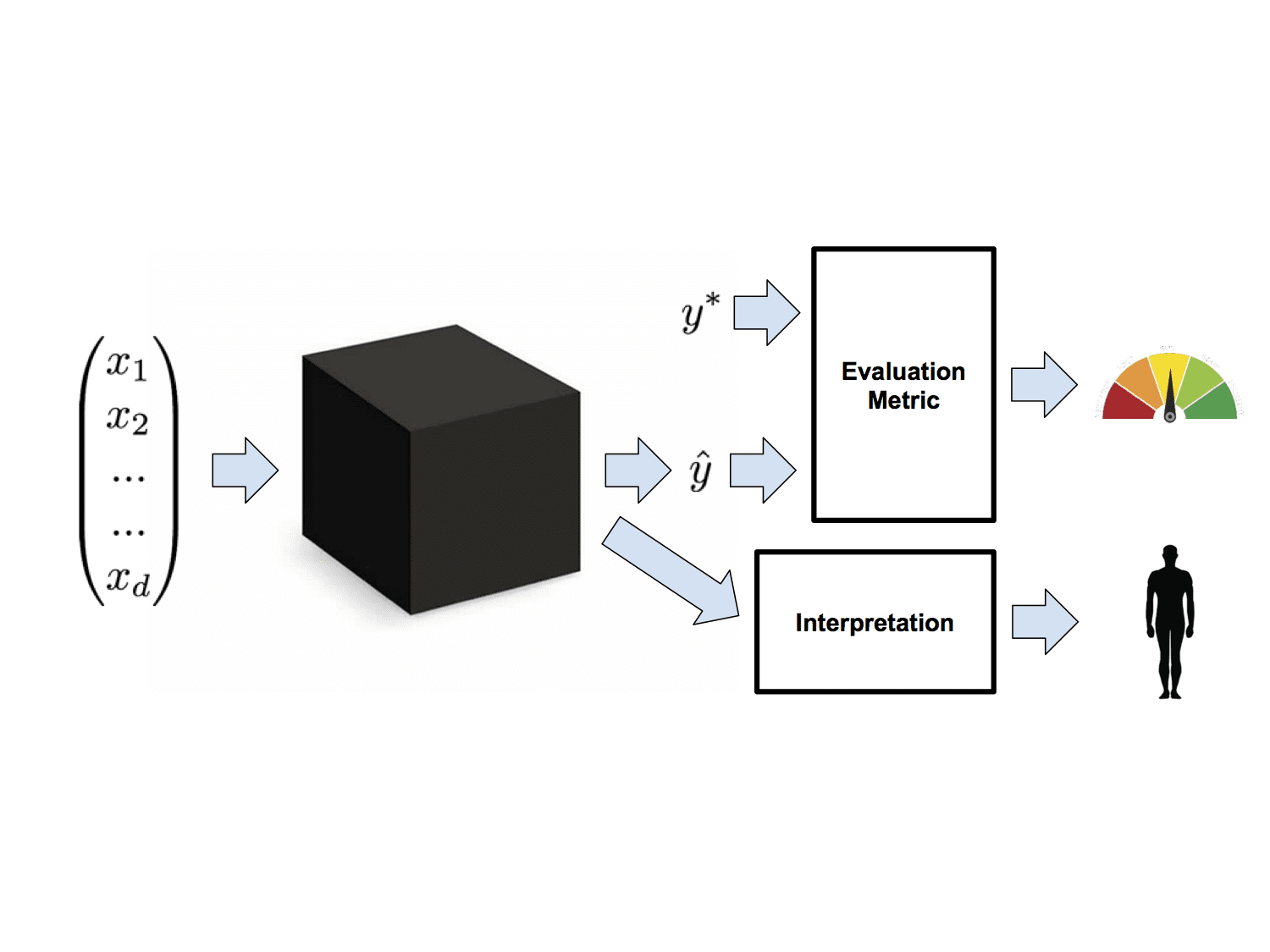
One solution is to go ahead and throw caution to the wind but then to interrogate the models to see if they're behaving acceptably. These efforts seek to interpret models to mitigate the mismatch between real and optimized objectives. The idea behind most work in interpretability is that in addition to the predictions required by our evaluation metrics, models should yield some additional information, which we term an interpretation. Interpretations can come in many varieties, notably transparency and post-hoc interpretability. The idea behind transparency is that we can introspect the model and determine precisely what it's doing. Unfortunately, the most useful models aren't especially transparent. Post-hoc interpretations, on the other hand, address techniques to extract explanations, even those from models we can't quite introspect. In the Mythos paper (https://arxiv.org/abs/1606.03490), I offer a broad taxonomy of both the objectives and techniques for interpreting supervised models.
model-metric-interpretation
Upgrade to More Sophisticated Paradigms of Learning
Another solution might be to close the gap between the real and modeled objectives. Some problems, like cost sensitivity, can be addressed within the supervised learning paradigm. Others, like causality, might require us to pursue fundamentally more powerful models of learning. Reinforcement learning (RL), for example, directly models an agent acting within a sequential decision making process. The framework captures the causal effects of taking actions and accounts for a distribution of data that changes per modifications to the policy. Unfortunately, practical RL techniques for sequential decision-making have only been reduced to practice on toy problems with relatively small action-spaces. Notable advances include Google Deepmind's Atari and Go-playing agents.
Several papers by groups including Steve Young's lab at Cambridge (paper), the research team at Montreal startup Maluuba (arxiv.org/abs/1606.03152), and my own work with Microsoft Research's Deep Learning team (arxiv.org/abs/1608.05081), seek to extend this progress into the more practically useful realm of dialogue systems.
Using RL in critical settings like medical care poses its own thorny set of problems. For example, RL agents typically learn by exploration. You could think of exploration as running an experiment. Just like a doctor might run a randomized trial, the RL agent periodically takes randomized actions, using the information gained to guide continued improvement of its policy. But when is it OK to run experiments with human subjects? To do any research on human subjects, even the most respected researchers are required to submit to an ethics board. Can we then turn relatively imbecilic agents loose to experiment on human subjects absent oversight?
Conclusions
Supervised learning is simultaneously unacceptable, inadequate, and yet, at present, the most powerful tool at our disposal. While it's only reasonable to pillory the paradigm with criticism, it remains nonetheless the most practically useful tool around. Nonetheless I'd propose the following takeaways:
  1. We should aspire to unseat the primacy of strictly supervised solutions. Improvements in reinforcement learning offer a promising alternative.
  2. Even within the supervised learning paradigm, we should work harder to eliminate those flaws of problem formulation that are avoidable.
  3. We should remain suspicious of the behavior of live systems, and devise mechanisms to both understand them and provide guard-rails to protect against unacceptable outcomes.

Zachary Chase LiptonZachary Chase Lipton is a PhD student in the Computer Science Engineering department at the University of California, San Diego. He is interested in both theoretical foundations and applications of machine learning. In addition to his work at UCSD, he has interned at Microsoft Research Labs and as a Machine Learning Scientist at Amazon, and is a Contributing Editor at KDnuggets.
Related:

mandag 28. november 2016

Start-up of the week: Instalocate- A chatbot that claims to make your travel more comfortable!


Img Source: Instalocate | www.instalocate.com

Did you know that every time your flight gets delayed your airlines owes you a compensation? Have you ever been denied boarding because the flight was overbooked? Are you aware of your rights as a flyer? Many a times we overlook on these issues and incur heavy losses, but not anymore. The one company founded by Stanford University and Indian Institute of Management (IIM) alumni in June 2016, is building an AI powered travel assistant just for you!

Instalocate– the name as it goes by – promises to watch all that for you by building a cutting-edge technology that can solve all your travel problems and make your journey comfortable. No more panicking and rushing to the airline counters, standing in long queues or calling the customer care if your flight gets delayed or baggages do not come on time! Instalocate promises to constantly monitor your travel and predict and solve the travel problems.

Not just that, it would also protect your rights as a customer and go after airlines to get your due compensation in case of any mishap.

How wonderful is that? Having a digital personal assistant that can make your journey comfortable and be always there to answer all your questions in an instant!

Talking to AIM, one of its founders Pallavi Singh revealed that the idea of Instalocate was conceived out of all the unfortunate incidences that she and her husband had personally faced.


“Anything that can go wrong has gone wrong with us. Flights have gotten delayed, we have missed connections, baggage was lost. And that’s when we realised that, most of the travel apps are working in pre-booking and there is no one to help you when things like this go wrong. Dealing with the airlines was the biggest nightmare amidst this”, she said.


And that’s how the journey to Instalocate took off with an idea of building an assistant which could help during the travel woes and deals with the airline on your behalf. Pallavi confesses “At so many times, we felt so frustrated with the airlines that we wanted to sue them for compensation, for all the trouble we went through. But we never did- mainly because we never had the time to deal with the airlines.”

With Instalocate, all you have to do is share your flight details and it will predict when you might need something and would send the contextual information automatically. Just ask your assistant anything from your flight status to the free Wi-Fi availability in the airport! That’s not all, if your family is worried about you, the assistant can pinpoint your exact location in the air. They don’t have to anxiously wait outside the airport checking their phones again and again! After reaching your destination, your cab will be waiting for you.

How is all of it achieved? Talking about the integration of artificial intelligence to Instalocate, Pallavi said “It is a predictive engine which will predict when the airlines owe you compensation. Unlike others we don’t wait for you to search for that information rather we will bring it to you. We are also building in-house NLP which makes it easier for an end user to talk to us, just as they would talk to a friend.”

There is no doubt that the bot has been received well by its users. “We have only launched our first product and the people are loving it”, marked Pallavi. Citing a use case, she said “One of our power users recently got 800 dollars from British Airways for flight delay with the help of Instalocate.”

However, the journey to its popularity was not easy. Pallavi notes that making was not as challenging as marketing. “Bots is still a new concept for people and popularizing it is a big problem”, she added.

Well, despite the challenges, Instalocate has done quite well for itself and is growing at a rate of 60 month over month with a pretty high retention rate. 

This digital personal assistant is available to make your journey comfortable and answer your questions in an instant. Talk to Instalocate within facebook at m.me/instalocate for a hassle-free travel now. There is no need to install the app separately, which adds to the many perks this travel bot has!

mandag 13. juni 2016

Everything you ever wanted or needed to know about Big Data #BigData


Big Data is a phrase that gets bandied about quite a bit in the media, the board room – and everywhere in between. It’s been used, overused and used incorrectly so many times that it’s become difficult to know what it really means. Is it a tool? Is it a technology? Is it just a buzzword used by data scientists to scare us? Is it really going to change the world? Or ruin it?
This post is all about demystifying the mess that has become Big Data, and more importantly demonstrating how you can use it to improve your bottom line.

What Is Big Data?

First of all, what is Big Data? In it’s purest form, Big Data is used to describe the massive volume of both structured and unstructured data that is so large it is difficult to process using traditional techniques. So Big Data is just what it sounds like – a whole lot of data.
The concept of Big Data is a relatively new one and it represents both the increasing amount and the varied types of data that is now being collected. Proponents of Big Data often refer to this as the “datification” of the world. As more and more of the world’s information moves online and becomes digitized, it means that analysts can start to use it as data. Things like social media, online books, music, videos and the increased amount of sensors have all added to the astounding increase in the amount of data that has become available for analysis.
Everything you do online is now stored and tracked as data. Reading a book on your Kindle generates data about what you’re reading, when you read it, how fast you read it and so on. Similarly, listening to music generates data about what you’re listening to, when how often and in what order. Your smart phone is constantly uploading data about where you are, how fast you’re moving and what apps you’re using.
What’s also important to keep in mind is that Big Data isn’t just about the amount of data we’re generating, it’s also about all the different types of data (text, video, search logs, sensor logs, customer transactions, etc.). In fact, Big Data has four important characteristics that are known in the industry as the 4 V’s:
  • Volume – the increasing amount of data that is generated every second
  • Velocity – the speed at which data is being generated
  • Variety – the different types of data being generated
  • Veracity – the messiness of data, ie. it’s unstructured nature
Based on the incredible amount, speed, variety and unstructuredness of the data we are now generating and storing, it’s no surprise that it quickly became unmanageable using traditional storing and analysis methods. This is where the term Big Data becomes confusing, because it is often used to refer to the new technologies, tools and processes that have sprung up to accommodate this vast amount of data.

Glossary of Big Data Terms

Inevitably, much of the confusion around Big Data comes from the variety of new (for many) terms that have sprung up around it. Here is a quick run-down of the most popular ones:
  • Algorithm – mathematical formula run by software to analyze data
  • Amazon Web Services (AWS) – collection of cloud computing services that help businesses carry out large-scale computing operations without needing the storage or processing power in-house
  • Cloud (computing) – running software on remote servers rather than locally
  • Data Scientist – an expert in extracting insights and analysis from data
  • Hadoop – collection of programs that allow for the storage, retrieval and analysis of very large data sets
  • Internet of Things (IoT) – refers to objects (like sensors) that collect, analyze and transmit their own data (often without human input)
  • Predictive Analytics – using analytics to predict trends or future events
  • Structured v Unstructured data – structured data is anything that can be organized in a table so that it relates to to other data in the same table. Unstructured data is everything that can’t.
  • Web scraping – the process of automating the collection and structuring of data from web sites (usually through writing code)

Why Has It Become So Popular

Big Data’s recent popularity has been due in large part to new advances in technology and infrastructure that allow for the processing, storing and analysis of so much data. Computing power has increased considerably in the past five years while at the same time dropping in price – making it more accessible to small and midsize companies. In the same vein, the infrastructure and tools for large-scale data analysis has gotten more powerful, less expensive and easier to use. According to
As the technology has gotten more powerful and less expensive, numerous companies have emerged to take advantage of it by creating products and services that help businesses to take advantage of all Big Data has to offer.  According to Inc, in 2012 the Big Data industry was worth $3.2 billion and growing quickly. They went on to say that “Total [Big Data] industry revenue is expected to reach nearly $17 billion by 2015, growing about seven times faster than the overall IT market”. For more on the size and projected growth of the Big Data industry, check out this Forbes article.
Businesses have also started taking notice of the Big Data trend. In a recent survey, “Eighty-seven percent of enterprises believe big data analytics will redefine the competitive landscape of their industries within the next three years.”

Why Should Businesses Care?

Data has always been used by businesses to gain insights through analysis. The emergence of Big Data means that they can now do this on an even greater scale, taking into account more and more factors. By analyzing greater volumes from a more varied set of data, businesses can derive new insights with a greater degree of accuracy. This directly contributes to improved performance and decision making within an organization.
Big Data is fast becoming a crucial way for companies to outperform their peers. Good data analysis can highlight new growth opportunities, identify and even predict market trends, be used for competitor analysis, generate new leads and much more. Learning to use this data effectively will give businesses greater transparency into their operations, better predictions, faster sales and bigger profits.

Best Big Data Tools

Taking advantage of all that Big Data has to offer can seem like a daunting task, but there are a number of tools (both free and paid) that can help businesses to collect, store, analyze and derive insight from Big Data. Here are just a few…

OpenRefine

OpenRefine is a data cleaning software that allows you to pre-process your data for analysis. This is especially useful if you are analyzing unstructured data or combining multiple data sets into one for analysis.

WolframAlpha

WorlframAlpha provides detailed responses to technical searches and does very complex calculations. For business users, it presents information charts and graphs, and is excellent for high level pricing history, commodity information, and topic overviews.

import.io

import.io is allows you to turn the unstructured data displayed on web pages into structured tables of data that can be accessed over an API.

Tableau

Tableau is a visualization tool that makes it easy to look at your data in new ways. In the analytics process, Tableau’s visuals allow you to quickly investigate a hypothesis, sanity check your instincts or build a compelling infographic to convince your audience with.

Google Fusion Tables

Google Fusion Tables is a versatile tool for data analysis, large data set visualization and mapping.

Best Additional Resources (blog posts, case studies, books, videos, etc)

If you’re interested in learning more about Big Data and how you can use it, here are a few of our favorite resources:

Blogs

  • No Free Hunch (kaggle) – Kaggle hosts a number of predictive modeling competitions. Their competition and data science blog, covers all things related to the sport of data science.
  • SmartData Collective – SmartData Collective is an online community moderated by Social Media Today that provides information on the latest trends in business intelligence and data management.
  • FlowingData – FlowingData explores the ways in which data scientists, designers, and statisticians use analysis, visualization, and exploration to understand data and ourselves.
  • KDnuggets – KDnuggets is a comprehensive resource for anyone with a vested interest in the data science community.
  • Data Elixir – Data Elixir is a great roundup of data news across the web, you can get a weekly digest sent straight to your inbox.

Online Courses/Learning Resources

  • DataCamp – DataCamp is a resource for learning data analysis and R interactively.
  • School of Data – School of Data offers a variety of courses designed for everyone, from the data science-newbie to the professional seeking inspiration.
  • Udemy – Udemy is the world’s largest destination for online courses with many in the data science field.
  • w3schools – W3schools is great online tutorials for learning basic coding and data analysis skills.

Videos

  • The Data Science Revolution – an expert panel that considerations of the future of data science and the ethics involved with data analytics and enhanced predictive powers.
  • Turning Big Data into Big Analytics – focuses on the opportunity businesses have when dealing correctly with their data and serves as a case study for data science professionals.

Books

Looking Ahead

What the future of Big Data really holds, no one can predict. The rapid development of new technologies, especially in the machine learning space, will undoubtedly usurp any predictions we try to make. What is certain, is that Big Data is here to stay. The amount of data we are producing is only going to increase and by analyzing it, we can learn and eventually be able to predict some pretty cool things. Very soon, Big Data will touch and transform every industry and every piece of your daily life.

Wrapping Up

Whether or not you believe the hype about whether Big Data will change the world, the fact remains that learning how to use the recent influx of data effectively can help you make better, more informed decisions. The thing to take away from Big Data isn’t it’s largeness, it’s the variety. You don’t necessarily need to analyze a lot of data to get accurate insights, you just need to make sure you are analyzing theright data. To really take advantage of this data revolution, you need to start thinking about new and varied data sources that can give you a more well rounded picture of your customers, market and competitors. With today’s Big Data technologies, everything can be used as data – giving you unparalleled access to market factors.
What’s your take on the future of Big Data? Leave a comment for us below!

onsdag 1. juni 2016

#DataForGood: California's going to try to solve the water crisis in the most sci-fi way possible


If you've ever thought to yourself, "Hm, I wonder how close we are to actually creating artificial intelligence," the answer is IBM's Watson.

The supercomputer/"Jeopardy" champion/Ridley Scott advisor is basically the closest we've come as a species to creating a machine that can think for itself. Well, the closest we've come so far.

Watson works through a concept called "cognitive computing." It basically means that instead of following rigid computer structures like decision trees and "if this, then that" types of programmable behavior, Watson takes in more information and context and can actually think about the solution to a problem.

It also gets smarter over time, building on its previous knowledge as it learns how to solve problems faster and more efficiently. Watson's cognitive abilities are pretty much endless, and so far, it's done some pretty cool stuff.

Watson partnered with the Institute of Culinary Education in New York City to create 65 recipes by learning about what ingredients go well together.

Watson has also read millions of medical studies to learn about health and wellness, and it can even guide you through an art museum while answering every question you have about the artists. Recently, Watson got a new job in California tracking water use.

The environmental consulting firm OmniEarth hired Watson to essentially be the overseer of water in California, a state often plagued by droughts and most recently a massive water shortage.

Watson will look at satellite images by the truckload and try to learn as much as it can. The more it looks at California's many farms, golf courses, vineyards, backyards, and deserts, the more it starts to recognize patterns and trends. It actually learns where all of California's water is going just by observing and thinking.

Then it can figure out who might be using too much and where more might need to be distributed.

"Watson doesn’t know anything about water usage or Earth images," said Jerome Pesenti, vice president of IBM’s Watson platform, to The Huffington Post. "But if you give it some training images, the system can take those as examples and learn from them." From there, Watson only gets smarter and better at its job. It's just information now, but California can use it to enact real change.

Local governments can use Watson's data to make customized water budgets for their communities. Also, because many people might not be aware they're overusing water, Watson can help with targeted messaging to those people, informing them of their potential water abuse and providing solutions and ways to cut back. Watson can also. Solving environmental crises requires the greatest minds of today.

In this case, one of those minds is a manmade computer that kicks ass on "Jeopardy." Whoever, or whatever, solves the problems challenging our environment will need to learn, think, and adapt on a massive scale and act as fast as possible. Watson is pretty much the perfect candidate. 

tirsdag 26. april 2016

Top 10 Big Data Technologies Of Present Times


Over last few years Big Data technologies are getting due attention and there are several trends and innovations in this space in recent times. 
Wednesday, October 22, 2014:  Big Data is a concept which is quite broad and comprises several trends and technology developments. Over last few years Big Data technologies are getting due attention and there are several trends and innovations in this space in recent times. Here we'll discuss top ten emerging Big Data technologies.

1. Column-oriented databases: 

Traditional databases are excellent in online transaction processing but when it comes to query performance while data volumes grow, these databases fall short on performance. The new column-oriented databases store data and focuses on columns and not rows. It allows huge data compression and faster query times.

2. Streaming Big Data analytics: 

There are several projects in this section including Storm, Spark, Data Torrent, Spring XD and SQL Stream. Apache Storm is an open source distributed real-time computation system which simplifies streams of data and real-time processing. Spark is a data processing platform which is compatible with Hadoop. DataTorrent is a real-time streaming platform which enables businesses to perform data processing. Spring XD supports streams for event driven data while SQLStream provides a distributed stream processing platform for streaming analytics, visualization and continuous integration of machine data.

3. Schema-less databases, or NoSQL databases: 

This database category includes key-value stores and document stores. This database focuses on storage and retrieval of large volumes of unstructured, semi-structured or even structured data.

4. SQL-in-Hadoop: 

This technology includes Apache Hive, Shark, Apache Drill, Presto and Phoenix among many others. It helps in making queries and it also manages large datasets in distributed storage. Shark is a data warehouse system which supports Hive's query language. Apache Drill is an Apache incubation project and it's designed for scalability. It's backed by MapR. Presto is an open source distributed SQL query engine and Phoenix is an open source SQL query engine for Apache Hbase.

5. MapReduce: 

It's a programming paradigm which allows massive job execution scalability against thousands of servers or clusters of servers. Its two tasks are Map task and Reduce task. It converts any input dataset into different set of value pairs while reducing set of tuples.

6. Hadoop: 

Hadoop is an open source platform for handling Big Data which can work with multiple data sources. It has other applications too and it's largely used for changing data like location-based data from weather or traffic sensors, web-based or social media data or machine-to-machine transactional data.

7. PIG: 

PIG brings the Hadoop project close to developers and business users and it's used by Perl like language allowing query execution over data stored on a Hadoop cluster. PIG was a project by Yahoo! But now it's completely open source.

8. Big Data Lambda Architecture: 

Lambda Architecture is a hybrid platform which combines real-time data and pre-computed data to provide a near-real time view of the data at all times. Its frameworks include Summingbird by Twitter and Lambdoop.

9. PLATFORA: 

It almost copies Hadoop and it requires developer knowledge to operate. It's a platform which turns queries into Hadoop jobs with immediate effect and creates an abstraction layer to simplify the datasets in Hadoop.

10. SkyTree: 

It's a high performance machine learning data analytics platform which handles Big Data. It's an essential part of Big Data.

Courtesy: TechRepublic and InfoQ 

Sanchari Banerjee, EFYTIMES News Network 

22 tips for better data science

These tips are provided by Dr Granville, who brings 20 years of varied data-intensive experience working with successful start-ups, small companies across various industries, and eBay, Visa, Microsoft, GE and Wells Fargo.

1. Leverage external data sources: tweets about your company or your competitors, or data from your vendors (for instance, customizable newsletter eBlast statistics available via vendor dashboards, or via submitting a ticket)

2. Nuclear physicists, mechanical engineers, and bioinformatics experts can make great data scientists.

3. State your problem correctly, and use sound metrics to measure yield provided by data science initiatives.

4. Use the right KPIs (key metrics) and the right data from the beginning, in any project. Changes due to bad foundations are very costly. This requires careful analysis of your data to create useful databases.

5. Fast delivery is better than extreme accuracy. All data sets are dirty anyway. Find the perfect compromise between perfection and fast return.

6. With big data, strong signals (extremes) will usually be noise. Here's a solution. 7. Big data has less value than useful data.

8. Use big data from third party vendors, for competitive intelligence.

9. You can build cheap, great, scalable, robust tools pretty fast, without using old-fashioned statistical science. Think about model-free techniques.

10. Big data is easier and less costly than you think. Get the right tools! Here's how to get started.

11. Correlation is not causation. This article might help you with this issue.

12. You don't have to store all your data permanently. Use smart compression techniques, and keep statistical summaries only, for old data. Don't forget to adjust your metrics when your data changes,to keep consistency for trending purposes.

13. A lot can be done without databases, especially for big data.

14. Always include EDA and DOE (exploratory analysis / design of experiment) early on in any data science projects. Always create a data dictionary. And follow the traditional life cycle of any data science project.

15. Data can be used for many purposes: · quality assurance · to find actionable patterns (stock trading, fraud detection) · for resale to your business clients · to optimize decisions and processes (operations research) · for investigation and discovery (IRS, litigation, fraud detection, root cause analysis) · machine-to-machine communication (automated bidding systems, automated driving) · predictions (sales forecasts, growth and financial predictions, weather)

16. Don't dump Excel. Embrace light analytics.

17. Data + models + gut feelings + intuition is the perfect mix. Don't remove any of these ingredients in your decision process.

18. Leverage the power of compound metrics: KPIs derived from database fields, that have a far betterpredictive power than the original database metrics. For instance your database might include a single keyword field but does not discriminate between user query and search category (sometimes because data comes from various sources and is blended together). Detect the issue, and create a new metric called keyword type - or data source. Another example is IP address category, a fundamental metric that should be created and added to all digital analytics projects.

19. When do you need true real time processing? When fraud detection is critical, or when processing sensitive transactional data (credit card fraud detection, 911 calls). Other than that, delayed analytics(with a latency of a few seconds to 24 hours) is good enough.

20. Make sure your sensitive data is well protected. Make sure your algorithms can not be tampered by criminal hackers or business hackers (spying on your business and stealing everything they can, legally or illegally, and jeopardizing your algorithms - which translates in severe revenue loss). An example of business hacking can be found in section 3 in this article.

21. Blend multiple models together to detect many types of patterns. Average these models. Here's a simple example of model blending.

22. Ask the right questions before purchasing software.