Advertisement

Viser innlegg med etiketten artificial intelligence. Vis alle innlegg

mandag 19. desember 2016

Modernizing data description


Illumination

In the recent times, few words (like Robotics, Artificial Intelligence, Analytics, Data Mining, Machine Learning, etc.) are powerful (sometime confusing) in IT industry.

In this competitive world, it is highly important for any software engineer to understand the concepts and usage of the emerging fields. Itz essential to survive in the rapid growth IT industry.

Based on my (l)earning through the premium technology institute and related work experience, I'm writing this article with the strong fundamentals and concepts around it.

Key Areas

In my view, these emerging fields are categorized into 4 key areas. Letz see them in details:

1. Statistics

We all know that Statistics is a study of how to collect, organizes, analyze, and interpret numerical information from data. Statistics can slip into two taxonomy namely:

1. Descriptive Statistics

2. Inferential Statistics


Descriptive statistics involves method of organizing, summering and picturing information from data. Familiar examples are Tables, Graphs, Averages. Descriptive statistics usually involve measures of central tendency (mean, median, mode) and measures of dispersion (variance, standard deviation, etc.)

Inferential statistics invokes method of using information from sample to draw conclusion about the population. Common terminologies are "Margin of error", "Statically Significant".


2. Artificial Intelligence (AI)

AI is a broad term referring to computers and systems that are capable of essentially coming up with solutions to problems on their own. The solutions aren’t hard-coded into the program; instead, the information needed to get to the solution is coded and AI (used often in medical diagnostics) uses the data and calculations to come up with a solution on its own.
As depicted above, AI is the super set of the listed components and so itz a vast area to explore.

3. Machine Learning (ML)

Machine learning is capable of generalizing information from large data sets, and then detects and extrapolates patterns in order to apply that information to new solutions and actions. Obviously, certain parameters must be set up at the beginning of the machine learning process so that the machine is able to find, assess, and act upon new data


4. Data Mining

Data mining is an integral part of coding programs with the information, statistics, and data necessary for AI to create a solution


In the traditional reporting model, the data source is retrospective to look back and examines the exposure of the existing information. Descriptive analytics are useful because they allow us to learn from past behaviors, and understand how they might influence future outcomes.

Inter Connectivity

On connecting the dots of the above said 4 platforms, Artificial Intelligence is the foundation which is followed by Machine Learning, Statistics and Data Mining, chronologically. In simple term, AI (Artificial Intelligence) is the super set of all paradigm.


Artificial Intelligence is a science to develop a system or software to mimic human to respond and behave in a circumference.

Evolution of Statistics, AI, ML and Data Mining is depicted in the below chart.


Need of Chat Bot

On analyzing where people really spend time, you’ll probably get the details where the users are. Chat Bot is the low hanging fruit in terms of business & technical opportunity.

A Chat Bot can be easily built into any major commonly used chat product like Facebook Messenger or Slack. Latest industry data indicates that the end users reached more usage band of messenger apps than social networks, as depicted below:


We've another dimension of Messenger App usage. According to Statista, most popular global mobile messenger apps usage is pointed below, as of April 2016. Itz based on number of monthly active users (in millions).


Next Gen - Messaging

If you think about your daily interactions online, it won’t be that surprising – you use Slack or Skype to communicate with your colleagues at work, you talk to your closest friends on Facebook in Messenger, you probably have several chats with different groups of your friends depending on interests etc.


Chat Bots shift the shopping experience from browsing (web/retail stores) to recommendation. Bots learn about you, much like a trusted friend or personal shopper.

Chat Bot in Business

In Artificial Intelligence, Chat Bot plays a key tool by providing feedback to users on purchases with customer service agents on hand to provide further assistance.

In China, not only is WeChat used by close to two thirds of 16-24 year-old online consumers, but the service has capitalized on its massive market share by offering functionality well beyond simple messaging by attempting to insert itself into as many stations along the purchase journey as possible.

As the major part of digital consumers’ purchase journeys and online lives, Chat Bot will need to be non-intrusive, obviously beneficial to the user and, perhaps most importantly, present themselves as an honest assistant, not an advertisement in disguise.

As the summation of my analysis, 2 key business benefits of Chat Bot usage:

1. High automation in manual contact center business; leads to drastic cost reduction

2. Continuous improvement (on usage) is possible with the usage of Machine Learning in AI intelligent Chat Bot

Conclusion

What you research today may eventually underpin how you deploy a successful Chat Bot application for your business sooner rather than later once all the kinks get worked out. Get ready, folks !!


søndag 11. desember 2016

The Deception of Supervised Learning

Do models or offline datasets ever really tell us what to do? Most application of supervised learning is predicated on this deception.
Imagine you're a doctor tasked with choosing a cancer therapy. Or a Netflix exec tasked with recommending movies. You have a choice. You could think hard about the problem and come up with some rules. But these rules would be overly simplistic, not personalized to the patient or customer. Alternatively, you could let the data decide what to do!
The ability to programmatically make intelligent decisions by learning complex decision rules from big data is a primary selling point of machine learning. Leaps forward in the predictive accuracy of supervised learning techniques, especially deep learning, now yield classifiers that outperform human predictive accuracy on many tasks. We can guess how an individual will rate a movie, classify images, or recognize speech with jaw-dropping accuracy. So why not make our services smart by letting the data tell us what to do?
Here's the rub.
While the supervised paradigm is but one of several in the machine learning canon, nearly all machine learning deployed in the real world amounts to supervised learning. And supervised learning methods doesn't tell us to doanything. That is, the theory and conception of supervised learning addresses pattern recognition but disregards the notion of interaction with an environment altogether.
[Quick crash course: in supervised learning, we collect a dataset of input-output (X,Y) pairs. The learning algorithm then uses this data to train a model. This model is simply a mapping from inputs to outputs. Now given a new input (such as a [drug,patient] pair), we can predict a likely output (say, 5-year survival). We determine the quality of the model by assessing its performance (say error rate or mean squared error) on hold-out data.]
machinelearning
Now suppose we train a model to predict 5-year survival given some features of the patient and the assigned treatment protocol. The survival model that we train doesn't know why drug A was prescribed to some patients and not others. And it has no way of knowing what will happen when you apply drug A to patients who previously wouldn't have received it. That's because supervised learning relies on the i.i.d. assumption. In short, this means that we expect the future data to be distributed identically like the past. With respect to temporal effects, we assume is that the distribution of data is stationary. But when we introduce a decision protocol based on a machine learning model to the world, we change the world, violating our assumptions. We alter the distribution of future data and thus should expect to invalidate our entire model.
For some tasks, like speech recognition, these concerns seem remote. Use of a voice transcription tool might not, in the short run, change how we speak. But in more dynamic decision-making contexts, the concerns should be paramount. For example, Rich Caruana of Microsoft Research showed a real-life model trained to predict risk of death for pneumonia patients. Presumably this information could be used to aid in triage. The model however, showed that asthma was predictive of lower risk. This was a true correlation in the data, but it owed to the more aggressive treatment such co-morbid patients received. Put simply, a researcher taking actions based on this information would be mistaking correlation for causation. And if a hospital used the risk score for triage, they would actually recklessly put the asthma patients at risk, thus invalidating the learned model model.
Supervised models can't tell us what to do because they fundamentally ignore the entire idea of an action. So what do people mean when they say that they act based on a model? Or when they say that the model (or the data) tells them what to do? How is Facebook's newsfeed algorithm curating stories? How is Netflix's recommender system curating movies?
Usually this means that we strap on some ad-hoc decision protocol to a predictive model. Say we have a model that takes a patient and a drug and predicts the probability of survival. A typical ad hoc rule might say that we should give the drug that maximizes the predicted probability of survival.
latex-image-2
But this classifier is contingent on the historical standard of care. For one drug, a model might predict better outcomes because the drug truly causes better outcomes. But for others causality might be reversed, or the association might owe to unobserved factors. These kinds of actions encode ungrounded assumptions mistaking correlative association for causal relationships. While oncologists are not so reckless as to employ this reasoning willy-nilly, it's precisely the logic that underlies less consequential recommender systems all over the internet. Netflix doesn't account for how its recommendations influence your viewing habits, and Facebook's algorithms likely don't account for the effects of curation on reader behavior.
The failure to account for causality or interaction with the environment are but two among many deceptions underlying the modern use of supervised learning. Other, less fundamental, issues abound. For example, we often optimize surrogate objectives that only faintly resemble our true objectives. Search engines assume that mouse clicks indicate accurately answered queries. This means that when, in a momentary lapse of spine, you click on a celebrity break-up story after searching for an egg-salad recipe, the model registers a job a well done.
Some other issues to heap on the laundry list of common deceptions:
  • Disregarding real-life cost-sensitivity
  • Erroneous interpretation of predicted probabilities as quantifications of uncertainty
  • Ignoring differences between constructed training sets and real world data
The overarching point here is that problem formulation for most machine learning systems can be badly mismatched against the real-world problems we're trying to solve. As detailed in my recent paper, The Mythos of Model Interpretability, it's this mismatch that leads people to wonder whether they can "trust" machine learning models.
Some machine learners suggest that the desire for an interpretation will pass - that it reflects an unease which will abate if the models are "good enough". But good enough at what? Minimizing cross-entropy loss on a surrogate task on a toy-dataset in a model that fundamentally ignores the decision-making process for which a model will be deployed? The suggestion is naive, but understandable. It reflects the years that many machine learners have spent single-mindedly focused on isolated tasks like image recognition. This focus was reasonable because these offline tasks were fundamental obstacles themselves, even absent the complication of reality. But as a result, reality is a relatively new concept to a machine learning community that increasingly rubs up against it.
So where do we go from here?
Model Interpretability
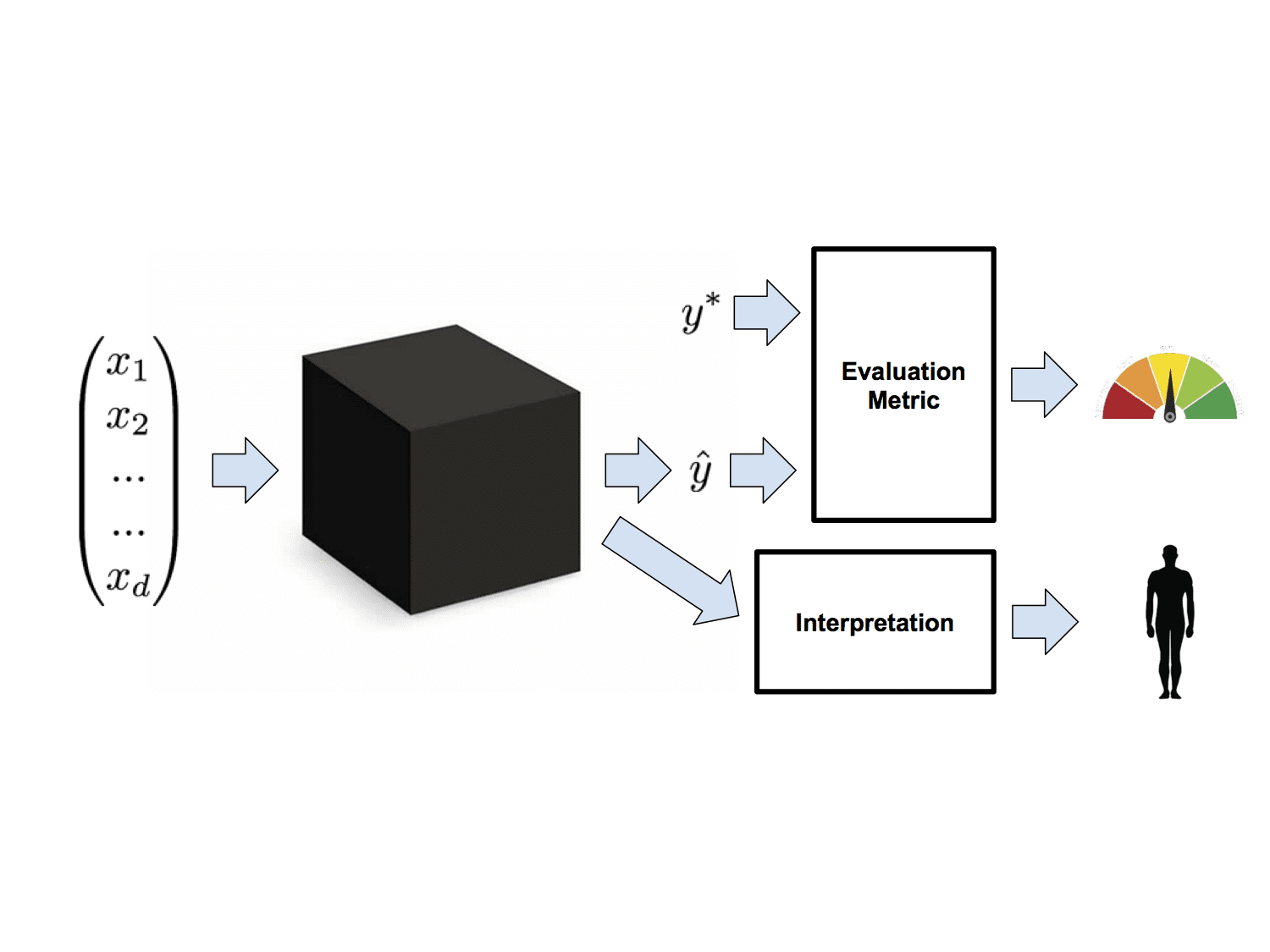
One solution is to go ahead and throw caution to the wind but then to interrogate the models to see if they're behaving acceptably. These efforts seek to interpret models to mitigate the mismatch between real and optimized objectives. The idea behind most work in interpretability is that in addition to the predictions required by our evaluation metrics, models should yield some additional information, which we term an interpretation. Interpretations can come in many varieties, notably transparency and post-hoc interpretability. The idea behind transparency is that we can introspect the model and determine precisely what it's doing. Unfortunately, the most useful models aren't especially transparent. Post-hoc interpretations, on the other hand, address techniques to extract explanations, even those from models we can't quite introspect. In the Mythos paper (https://arxiv.org/abs/1606.03490), I offer a broad taxonomy of both the objectives and techniques for interpreting supervised models.
model-metric-interpretation
Upgrade to More Sophisticated Paradigms of Learning
Another solution might be to close the gap between the real and modeled objectives. Some problems, like cost sensitivity, can be addressed within the supervised learning paradigm. Others, like causality, might require us to pursue fundamentally more powerful models of learning. Reinforcement learning (RL), for example, directly models an agent acting within a sequential decision making process. The framework captures the causal effects of taking actions and accounts for a distribution of data that changes per modifications to the policy. Unfortunately, practical RL techniques for sequential decision-making have only been reduced to practice on toy problems with relatively small action-spaces. Notable advances include Google Deepmind's Atari and Go-playing agents.
Several papers by groups including Steve Young's lab at Cambridge (paper), the research team at Montreal startup Maluuba (arxiv.org/abs/1606.03152), and my own work with Microsoft Research's Deep Learning team (arxiv.org/abs/1608.05081), seek to extend this progress into the more practically useful realm of dialogue systems.
Using RL in critical settings like medical care poses its own thorny set of problems. For example, RL agents typically learn by exploration. You could think of exploration as running an experiment. Just like a doctor might run a randomized trial, the RL agent periodically takes randomized actions, using the information gained to guide continued improvement of its policy. But when is it OK to run experiments with human subjects? To do any research on human subjects, even the most respected researchers are required to submit to an ethics board. Can we then turn relatively imbecilic agents loose to experiment on human subjects absent oversight?
Conclusions
Supervised learning is simultaneously unacceptable, inadequate, and yet, at present, the most powerful tool at our disposal. While it's only reasonable to pillory the paradigm with criticism, it remains nonetheless the most practically useful tool around. Nonetheless I'd propose the following takeaways:
  1. We should aspire to unseat the primacy of strictly supervised solutions. Improvements in reinforcement learning offer a promising alternative.
  2. Even within the supervised learning paradigm, we should work harder to eliminate those flaws of problem formulation that are avoidable.
  3. We should remain suspicious of the behavior of live systems, and devise mechanisms to both understand them and provide guard-rails to protect against unacceptable outcomes.
Zachary Chase LiptonZachary Chase Lipton is a PhD student in the Computer Science Engineering department at the University of California, San Diego. He is interested in both theoretical foundations and applications of machine learning. In addition to his work at UCSD, he has interned at Microsoft Research Labs and as a Machine Learning Scientist at Amazon, and is a Contributing Editor at KDnuggets.
Related:

mandag 28. november 2016

Start-up of the week: Instalocate- A chatbot that claims to make your travel more comfortable!


Img Source: Instalocate | www.instalocate.com

Did you know that every time your flight gets delayed your airlines owes you a compensation? Have you ever been denied boarding because the flight was overbooked? Are you aware of your rights as a flyer? Many a times we overlook on these issues and incur heavy losses, but not anymore. The one company founded by Stanford University and Indian Institute of Management (IIM) alumni in June 2016, is building an AI powered travel assistant just for you!

Instalocate– the name as it goes by – promises to watch all that for you by building a cutting-edge technology that can solve all your travel problems and make your journey comfortable. No more panicking and rushing to the airline counters, standing in long queues or calling the customer care if your flight gets delayed or baggages do not come on time! Instalocate promises to constantly monitor your travel and predict and solve the travel problems.

Not just that, it would also protect your rights as a customer and go after airlines to get your due compensation in case of any mishap.

How wonderful is that? Having a digital personal assistant that can make your journey comfortable and be always there to answer all your questions in an instant!

Talking to AIM, one of its founders Pallavi Singh revealed that the idea of Instalocate was conceived out of all the unfortunate incidences that she and her husband had personally faced.


“Anything that can go wrong has gone wrong with us. Flights have gotten delayed, we have missed connections, baggage was lost. And that’s when we realised that, most of the travel apps are working in pre-booking and there is no one to help you when things like this go wrong. Dealing with the airlines was the biggest nightmare amidst this”, she said.


And that’s how the journey to Instalocate took off with an idea of building an assistant which could help during the travel woes and deals with the airline on your behalf. Pallavi confesses “At so many times, we felt so frustrated with the airlines that we wanted to sue them for compensation, for all the trouble we went through. But we never did- mainly because we never had the time to deal with the airlines.”

With Instalocate, all you have to do is share your flight details and it will predict when you might need something and would send the contextual information automatically. Just ask your assistant anything from your flight status to the free Wi-Fi availability in the airport! That’s not all, if your family is worried about you, the assistant can pinpoint your exact location in the air. They don’t have to anxiously wait outside the airport checking their phones again and again! After reaching your destination, your cab will be waiting for you.

How is all of it achieved? Talking about the integration of artificial intelligence to Instalocate, Pallavi said “It is a predictive engine which will predict when the airlines owe you compensation. Unlike others we don’t wait for you to search for that information rather we will bring it to you. We are also building in-house NLP which makes it easier for an end user to talk to us, just as they would talk to a friend.”

There is no doubt that the bot has been received well by its users. “We have only launched our first product and the people are loving it”, marked Pallavi. Citing a use case, she said “One of our power users recently got 800 dollars from British Airways for flight delay with the help of Instalocate.”

However, the journey to its popularity was not easy. Pallavi notes that making was not as challenging as marketing. “Bots is still a new concept for people and popularizing it is a big problem”, she added.

Well, despite the challenges, Instalocate has done quite well for itself and is growing at a rate of 60 month over month with a pretty high retention rate. 

This digital personal assistant is available to make your journey comfortable and answer your questions in an instant. Talk to Instalocate within facebook at m.me/instalocate for a hassle-free travel now. There is no need to install the app separately, which adds to the many perks this travel bot has!

søndag 7. august 2016

The 7 Steps of a Data Project

steps

Well, building your first data project is actually not that hard. And yes, Dataiku DSS helps, but what will really helps you is understanding the data science process. Becoming data driven is about this: knowing the basic steps and following them to go from raw data to building a machine learning model.
The steps to complete a data project have been conceptualized a while ago as the KDD process (forKnowledge Discovery in Databases), and made popular with lots of vintage looking graphs like this one.
kdd
This is our take on the steps of a data project in this awesome age of big data!

STEP 1: UNDERSTAND THE BUSINESS

Business goal in data project
Understanding the business is the key to assuring the success of your data project. To motivate the different actors necessary to getting your project from design to production, your project must be the answer to a clear business need. So before you even think about the data, go out and talk to the people who could need to make their processes or their business better with data. Then sit down and define a timeline and concrete indicators to measure. I know, processes and politics seem boring, but in the end, they turn out to be quite useful!

If you’re working on a personal project, playing around with a dataset or an API, this may seem irrelevant. It’s not. Just downloading a cool open data set is not enough. I can’t tell you how many cool datasets I downloaded and never did anything with… So settle on a question to answer, or a product to build!

STEP 2: GET YOUR DATA

Once you’ve gotten your goal figured out, it’s time to start looking for your data. Mixing and merging data from as many data sources as possible is what makes a data project great, so look as far as possible.

Here are a few ways to get yourself some data:
  • Connect to a database: ask your data and IT teams for the data that’s available, or open your private database up, and start digging through it, and understanding what information your company has been collecting.
  • Use APIs: think of the APIs to all the tools your company’s been using, and the data these guys have been collecting. You have to work on getting these all set up so you can use those email open/click stats, the information your sales team put in Pipedrive or Salesforce, the support ticket somebody submitted, etc. If you’re not an expert coder, plugins in DSS give you lots of possibilities to bring in external data!
  • Look for open data: the Internet is full of datasets to enrich what you have with extra information; census data will help you add the average revenue for the district where your user lives, or open street maps can show you how many coffee shops are on his street. A lot of countries have open data platforms (like data gov in the US). If you’re working on a fun project outside of work, these open data sets are also an incredible resource! Check out kaggle, or this github with lots of datasets for example
  • Use more APIs: another great way to start a personal project is to make it super personal by working on your own data! You can connect to your social media tools, like twitter, or facebook, to analyze your followers and friends. It’s extremely easy to set up these connections with tools like ifttt. For example, I have a bunch of recipes that collect the music I listen to, the places I visit, my steps and the kilometers I run, the contacts I add, etc. And this can be useful for businesses as well! You can analyze very interesting trends on twitter, or even monitor the competition.

STEP 3: EXPLORE AND CLEAN YOUR DATA

(AKA the dreaded preprocessing step that typically takes up 80% of the time dedicated to a data project)
Once you’ve gotten your data, it’s time to get to work on it! Start digging to see what you’ve got and how you can link everything together to answer your original goal. Start taking notes on your first analyses, and ask questions to business people, or the IT guys, to understand what all your variables mean! Because not everyone will get that c06xx is a product category referring to something awesome.

Once you understand your data, it’s time to clean it! You’ve probably noticed that even though you have a country feature for instance, you’ve got different spellings, or even missing data. It’s time to look at every one of your columns to make sure your data is homogeneous and clean.
Warning! This is probably the longest, most annoying step of your data project. Data scientists report data cleaning is about 80% of the time spent on a project. So it’s going to suck a little bit. Luckily, tools like Dataiku DSS can make this much faster!

STEP 4: ENRICH YOUR DATASET

enriching in data project
Now that you’ve got clean data, it’s time to manipulate it to get the most value out of it. This is the time to join all your different sources, and group logs, to get your data down to the essential features.

You’ll then start manipulating the data to extract lots of valuable features. For example, getting a country and even a town out of a visitor’s IP address. Extracting time of day, or week of year from your dates to get something more meaningful.
The possibilities are pretty much endless, and you’ll get a pretty good idea by scrolling through Dataiku DSS’s processors in the Lab of the operations you can execute.

STEP 5: BUILD VISUALISATIONS

building insights and graphs in data project
You now have a nice dataset (or maybe several), so this is a good time to start exploring it by building graphs. When you’re dealing with large volumes of data, they’re the best way to explore and communicate your findings.

You’ll find lots of tools available that make this step fun to prepare and to receive. The tricky part is always to be able to dig into your graphs to answer any question somebody would have about an insight. That’s when the data preparation comes in handy: you’re the guy who did the dirty work so you know the data like the palm of your hand!
If this is the final step of your project, it’s important to use APIs and plugins so you can push those insights to where your end users want to have them. So get integrated with their tools!
Your graphs don’t have to be the end of your project though. They’re a way to uncover more trends that you want to explain. They’re also a way to develop more interesting features. For example, by putting your data points on a map you could perhaps notice that specific geographic zones are more telling than specific countries or cities.

STEP 6: GET PREDICTIVE

building insights and graphs in data project

By working with clustering algorithms (aka unsupervised), you can build models to uncover trends in the data that were not distinguishable in graphs and stats. These create groups of similar events (or clusters) and more or less explicitly express what feature is decisive in these results. Tools like Dataiku DSS help beginners run basic open source algorithms easily in clickable interfaces.
More advanced data scientists can then go even further and predict future trends with supervised algorithms. By analyzing past data, they find features that have impacted past trends, and use them to build predictions. More than just gaining knowledge, this final step can lead to building whole new products and processes. To get these in production though, you’ll need the intervention of data scientists and engineers, but it’s important to understand the process so all the parties involved (business users and analysts as well), will be able to understand what comes out in the end.

STEP 7: ITERATE

building insights and graphs in data project
The main goal in any business project is to prove it’s effectiveness as fast as possible to justify, well, your job. Data projects are the same. By gaining time on data cleaning and enriching, you can go to the end of the project fast and get your first results. These first insights will be a great start to uncover more necessary cleaning, to develop more features in order to continuously improve results and model outputs.

data_science_project_process
Now that you’ve got the skills, get started right now by building projects in Dataiku DSS!

fredag 17. juni 2016

How to Become a Data Scientist (Part 2/3)

Having read Chapters One and Two (i.e. Part One), you should now have a good comprehension of what commercial data science entails, the different forms it takes, and what is required to be a success in the profession. And having thought deeply about your motivations, you should have a clear picture of your goals, and ultimately – the type of data scientist you want to become. So give yourself a pat on the back, because you are now ready to begin the real fun: learning.
In this chapter, we will explore the options at your disposal – but first – we will begin proceedings by discussing an important notion that concerns data science and learning.

Continual Learning
Just like a doctor has to stay abreast of medical developments, learning never stops for a data scientist. The field (and the technology) is evolving so quickly; what you learn now might not be relevant in the years to come. Look at the rise of deep learning, to take just one example. This is what Sean McClure was alluding to in his post emphasising the importance of problem solving (highlighted in Chapter One).
Quite simply, if you are not passionate about the field and do not enjoy learning, then data science is not for you. Conferences and networking with the data science community are effective ways of keeping on top of the latest developments. And regularly reading books and papers is very important (on this: if you do not have a research background, it is worth learning how to read academic papers properly).

Play. Build. Experiment.
Going back to the message we touched on in Chapter One, there is only one-way to develop your capability as a data scientist: experience, experience, experience. I could launch into a lengthy discussion on this, but I happened to come across two excellent posts that cover the points I wanted to make, so have a read of Brandon Rohrer: A One-Step Program for Becoming a Data Scientist and Rossella Blatt Vital: The Scary Rise of the 'Fake Data Scientists'.
This is what should you take from these: data science is an expert field, it takes a long time to master, and you will only do so through practical experience. As James Petterson summarised:
“Nothing beats experience. You can read as much as you want, you can do all the Coursera courses, but unless you get your hands dirty, you won’t learn”
The good news is there are some great avenues to gain practical experience, and we will turn our attention to these now.  

Kaggle / Open-Source / Freelancing
If you haven’t heard of Kaggle, Google it... NOW! Kaggle is an incredible platform where you can play around, develop your expertise and learn, of course. James put it this way:
“If I hadn’t competed in Kaggle competitions, I would have finished my PhD without knowing the tools that people use in industry. For example, a lot of the methods used in industry are based on ensembles or decision trees, like random forests. They are really powerful and are my first choice in both competitions and industry, but I wasn't exposed to them during my PhD”
There you have it: you can improve your skills while learning the techniques that are commonly applied in industry. And if you start doing well in the competitions, it provides evidence of your capability, as we will see in Chapter Four.
Outside of Kaggle, another option is to contribute to open-source projects. A simple search on GitHub should reveal some projects you can start to sink your teeth into, and gain practical experience while doing so.
Finally, if you can get freelancing work, this is a great way to build a track record and demonstrates that you can operate in a commercial environment. And rather conveniently, you could even utilize the Experfy platform for that purpose.

To PhD or not to PhD
Do you need a PhD to be a data scientist? Not necessarily, but there are many advantages, as Sean Farrell noted: 
“The process of obtaining a PhD is a filter for creative problem solving skills [and it] shows you can master a particular field in a short space of time and become a world expert, which proves you’ll be able to do it again and again”
And apart from anything, it provides you with the time to study and to develop your skills. Furthermore, if you are interested in specialising within a specific area like image processing or natural language processing, then PhD research is certainly worth considering.
But going down this path is not the only way to data science. James did a PhD in Machine Learning (focused on researching a very specific type of method) and he feels that a lot of PhD research is not always applicable to industry, i.e. if your job is to apply machine learning rather than research it, you don’t necessarily need a PhD. As such, I asked him whether he thinks people should choose a PhD based on its relevance to industry and he said:
“If possible, but that’s really hard because most of what we do in industry is not state of the art, we use methods that have been around for years and apply them to different problems. There are exceptions of course: you might work at Google in research, for example. But most of the knowledge I use day-to-day, I learnt working [at Commonwealth Bank] and by competing in Kaggle. Of course, doing a PhD, you learn about the whole process, spend a lot of time doing experiments and learning how to do them properly, and that is valuable. But I wonder if you could learn that from other means?”
Given the right motivations and armed with an informative guide on how to become a data scientist (where could you find one of those I wonder?), I have no doubt it is possible to learn by yourself. But it is worth making the point again: there are no shortcuts; it requires a lot of self-study and getting your hands dirty – whatever path you take.
There is also the employability aspect to consider: are you more employable as a PhD graduate vs. spending the same time on self-study? I do not have sufficient evidence to comment, but either way, it is more important whether you have truly spent the time building up expert capability (and how you can evidence this). PhD’s are certainly valuable but there are great data scientists with PhD’s and great ones without.
Other University Degrees 
So a PhD is not for you – perhaps it is the cost, or perhaps you have not yet developed the expertise necessary for research of this nature. Whatever the reason – there is no need to panic – because many universities are now offering Bachelors, Masters and Diplomas specifically designed for data science, where both computer science and mathematics/statistics are on the curriculum (the attentive reader will remember this from Chapter Two). 
Courses like these will certainly take you in the right direction, but take note: they won't be enough to convert you into a ready-made data scientist, because as we know – that takes experience. 

Online Courses
In a similar sense – even if you come from another quantitative field – a few online courses will not make you an expert, and remember: this is an expert field. But even if an online course was enough to master a chosen subject, you will still face competition, who – in all likeliness – will have far more practical and commercial experience in these areas. This is really important to be conscious of, and so we will return to this in Chapter Four. 
All this being said, online courses are incredibly useful tools to help kick-start your journey, or begin learning a new area (like deep learning, for example). The most popular courses are found via Coursera, Udacity and edX, with Dylan Hogg describing Andrew Ng’s Machine Learning on Coursera as “an absolute pre-requisite for anyone who does not have a research background”.
The following is by no means a complete list, or mandatory for that matter, but these also stood out to Dylan and some of the other data scientists we have met so far:
During my interactions with the Experfy team, I've found out that they were also launching a training platform. You can see a preview here. 
Books
Needless to say: good books are an invaluable resource and our favourite data scientists advocated the following:

Presenting / Communicating
If you do not have a natural disposition for communicating – especially with non-technical people – this is something you will need to work on (see Chapter One for why). Gaining practice and obtaining feedback is the best way to improve your soft skills, although Yanir also recommended the classic book by Dale Carnegie: How to Win Friends and Influence People.

lørdag 4. juni 2016

Using a predictive analytics model to foresee flight delays

Imagine an app that can predict flight delays. The ebook, Using a Predictive Analytics Model to Foresee Flight Delays, describes how data scientists and developers can build such an application. The app uses the Apache Spark machine learning library (MLlib), fueled by publicly available airplane flight data and enriched with weather data, to predict flight delays caused by weather conditions. When a delay is likely, the app can also help determine the degree to which the flight will be delayed. 
To build the app, you’ll learn how to use a get-build-analyze methodology and the IBM Analytics for Apache Spark service, which includes an interactive Jupyter Notebook. Using this methodology you’ll learn the following from three key sections of the ebook: 
  • Get data from various sources, including weather and flight patterns. 
  • Build the data collected, and test a predictive model.
  • Analyze the data for business advantage, and quantify the impact of weather on flight delays. 
Download this ebook to get started building this flight prediction application, and gain inspiration for your next data science projects.  

onsdag 1. juni 2016

Industry Speaks: Top 33 Big Data Predictions for 2016


By Alex Woodie
What will happen in big data in 2016? You’d think that would be a cinch to answer, what with all the deep neural net and prescriptive analytic progress being made these days. But in fact the big data predictions from the industry are all over the map.Datanami received dozens of predictions from prominent players in the industry. Here is a culled collection of the most interesting ones.
Oracle sees the rise of a new type of user: the Data Civilian. “While complex statistics may still be limited to data scientists, data-driven decision-making shouldn’t be,” Big Red says. “In the coming year, simpler big data discovery tools will let business analysts shop for datasets in enterprise Hadoop clusters, reshape them into new mashup combinations, and even analyze them with exploratory machine learning techniques.”
Nucleus Research is going out on a limb and predicting the death of big data as we know it. “In the past two years everyone and their dog seems to have launched a big data solution of some kind. It’s time for the shiny object syndrome to stop,” it says. “Instead of attacking the monolithic and daunting task of big data analysis, users will approach and access it like any data.”
Since even canines are pulling down big VC money for data startups, it may be time to start asking tough questions, according to Keri Smith, senior vice president at Opera Solutions. “What is the real ROI of a big data solution?” Smith asks. “How can companies get beyond departmental deployments to maximize the value of big data across the enterprise? And what are the meaningful use cases across a variety of verticals? If your company isn’t asking these questions and actively seeking answers, it should soon.”

We’ll see the rise of Data Jedis in 2016, says Matt Bencke, CEO of Spare5. “More jobs will be changed by AI than ever before and the ‘Data Jedis’ will become the most sought after employees,” he writes. “Machine learning+human insights will infiltrate new industries including healthcare and security and employees will need to adapt to providing a different service or get left behind in 2015.”
Data science will be big in banking, predicts Mike Weston, CEO of data science consultancy Profusion. “The financial industry is one of the pioneers of data science techniques,” he writes. “Nevertheless, the adoption of data science has been far from uniform across all banking services. In 2016 I expect this picture to change. Better use of data and personalisation of services will move from the financial markets to retail banking. It will have a profound impact on marketing, customer service and product development.”
The prospect of advanced AI giving rise to robot overlords scares Elon Musk. But according to Jans Aasman, a cognitive scientist and CEO ofFranz, AI should be placed the “friendlies” column. “Artificial intelligence and cognitive computing will make personalized medicine a reality, help save the lives of people with rare diseases and improve the overall state of healthcare in 2016 and beyond,” he says.
Chief Data Officers (CDOs) will become the “new it girl” of information tech, complicating office politics forever, argues Michael Ludwig, head of Blazent’s Office of the CTO. “Driven by the complexity of big data and the need for complete and accurate data, the CDO will become increasingly important,” he writes. “As a result, the CTO and CIO will need to make room for the CDO, and tension will emerge within the C-suite until clearly defined roles and associated teams are established.”
Not everybody sees it that way, including Craig Zawada, Chief Visionary Officer at PROS. “In 2016, we’ll begin to see erosion in the appointment of Chief Data Officers, a role of the past. Instead, Chief Insight Officers will emerge in 2016 as crucial leaders in the big data compilation process.”
CIOs, yeah baby!
But can the mighty CIO get his mojo back? Cazena founder and CEO Prat Moghe’s looks into his crystal ball, and says it’s so. “In 2016, CIOs will take advantage of enterprise-ready cloud services to become brokers of cloud services that meet IT mandates for governance, compliance and security as well as business needs for agility and responsiveness,” he writes.
Streaming analytics will start to mature and prove its worth in the big data lineup, predicts Phu Hoang, the CEO and co-founder ofDataTorrent. “While lots of companies have already accepted that real-time streaming is valuable, we’ll see users looking to take it one step further to quantify their streaming use cases. In the next year, customers using streaming tools will reach new levels of sophistication and demand a quantified ROI for streaming analytics,” he says.
Real-time analytics will be hot next year. We get it. But one technology—Apache Kafka–stands taller than the rest, according to MongoDB‘s VP of strategy Kelly Stirman. “Kafka will become an essential integration point in enterprise data infrastructure, facilitating the creation of intelligent, distributed systems,” Stirman writes. “Kafka and other streaming systems like Spark and Storm will complement databases as critical pieces of the enterprise stack for managing data across applications and data centers.”
Like drums? Then you’re going to love 2016, says Badri Raghavan, the chief data scientist at FirstFuel Software. “In the months ahead, we will see organizations and individuals tap data and analytics to deliver personalized and engaging experiences across industries including energy, sports, social good and music. For instance, people will be able to use data to change a song based on their personal preferences (e.g., lots of drum).”
How will the IoT impact the semiconductor business? IT legend Ray Zinn has a few thoughts on that. “You will see greater divisions between design and fabrication,” he writes. “Fabs will have the mission of scale to serve a few billions consumers and the nascent Internet of Things (IoT) markets. Design will become uniquely divorced from fabrication, splitting the market risk. Design firms will survive best by innovation, and fabs through ruthless efficiency. The question is what comes next? There will inevitably be new markets and devices that will drive a new growth spurt. The IoT is the sleeping giant, but I doubt the only one snoozing.”
Machine learning, big data automation, and artificial intelligence were big in 2015, and will get bigger next year, says Abdul Razack, SVP & head of platforms, big data and analytics at Infosys. “In 2016, the pace at which enterprises more widely adopt artificial intelligence to replace manual, repetitive tasks will rapidly increase,” Razack says, citing the $1 billion AI investmentmade recently by Toyota. Big data automation is already growing, but next year “it will be more widely used to accentuate the unique human ability to take complex problems and deliver creative solutions to them.” The self-driving cars from Tesla have built-in machine learning, but next year, “machine learning will quietly find its way into the household, making the objects around us not just connected.”
Lots of people see exciting things happening in the big data space in 2016. Not Charles Caldwell, the vice president of solutions engineering and services at Logi Analytics. “When I look ahead to 2016, I don’t see a lot of exciting things happening. Other vendors have come out with their predictions around cloud, visual analytics and mobile, but most of those things are old trends that are settling down. In my opinion, 2016 will be a year of consolidation and ground building for the next big thing.”
The “Not In Your Wildest Dreams” award goes to Peter Eicher, senior manager for product marketing at Catalogic Software. We’re not talking about his prediction that copy data management (CDM) “is a technology whose time has come as evidenced not only by the new vendors in the space but by old school players chiming in with ‘me too’ arguments.” That makes total sense. No, we’re calling Peter out for his crazy prediction that the New York Knicks win the NBA Championship. “Yeah, not happening,” he admits. “I can’t be right all the time. On the other hand, that prediction has been wrong for 42 years running. One of these days….”
The “Debbie Downer” award for big data goes to BlueTalonCEO Eric Tilenius for his prediction that the pace of big data breaches at major enterprises may rise. “In 2016, the lack of unified data governance could lead to the biggest security disruption that enterprises have ever faced—comparable to the disruption caused to the traditional enterprise perimeter by the entry of mobile,” he writes. “Relying on a fragmented approach to control data access, where inconsistent policies are applied across an ever-changing data landscape, will leave gaping holes in the protection of enterprise data.”
Are you into microservices? If not, you will be soon, according to SaaS heavy Workday. “It’s clear that the on-premise versus cloud battle is over. Cloud has won,” the company says. “Yet, not all cloud architectures will be created equal. Microservices architectures will go beyond the realm of consumer Internet designs like Netflix and become the most important architecture advancement in enterprise applications since the shift to the cloud.”
Big data is hard, and companies will struggle with it next year, says Ulrik Pederson, CTO of TARGIT. “2016 will see an expansion of big data analytics with tools that make it possible for business users to perform comprehensive self-service exploration with big data when they need it, without major hand holding from IT,” he writes. “Corresponding with my first predication, I anticipate a huge increase in advanced analytics projects across industries. However, that doesn’t mean they’ll be successful…. I wouldn’t be surprised to hear of many vendors and customers struggling to implement successfully.”
The International Institute of Analytics sees the rise of analytics microservices to facilitate embedded analytics. The IIA also sees progress being made in areas of cognitive technology, data science, and data curation. Oh, and the analytics talent crutch will ease as many new university program come online, the group says.
Elnur/Shutterstock.com
People who aren’t data geeks will get into the big data swing of things, says Bruno Aziza, Chief Marketing Officer of OLAP-on-Hadoop provider AtScale. “As Hadoop becomes more accessible to non-data geeks, marketers will begin to access more data for better decision making,” he writes. “Hadoop’s deeper and wider view of data will enable marketers to capture behaviors leading to decisions and understand the processes underlying customer journeys.”
We’ll see more HPC tech making its way into the mainstream, particularly as it pertains to storage, predicts storage giant DDN. “Storage, data management and application acceleration technologies from the HPC industry will continue being tapped at even a higher rate in 2016 to meet the evolving requirements of performance and scale and will replace traditional IT infrastructures at even a higher rate,” the company says.
Impressed with open source big data tech? You haven’t seen anything yet, says Pentaho CEO Quentin Gallivan. “The explosion of cool new tools like Spark, Docker, Kafka, Solr–emerging open source tools designed to enable large-scale, high-volume analytics on petabytes of data are moving from the ‘awkward teenager’ phase to the ‘bearded hipster’ phase,” Gallivan writes.
Spark will kill MapReduce, but save Hadoop, says Monte Zweben, co-founder and CEO of RDBMS-on-Hadoop vendor Splice Machine. “MapReduce is quite esoteric. Its slow, batch nature and high level of complexity can make it unattractive for many enterprises,” he writes. “Spark, because of its speed, is much more natural, mathematical, and convenient for programmers. Spark will reinvigorate Hadoop, and in 2016, nine out of every 10 projects on Hadoop will be Spark-related projects.”
But that doesn’t mean every Spark project will involve Hadoop, says Bob Muglia, the CEO ofSnowflake Computing. “Today, Spark is part of Hadoop distributions and is widely associated with Hadoop. Expect to see that change in 2016 as Spark goes its own way, establishing a separate, vibrant ecosystem. In fact, you can expect to see the major cloud vendors release their own Spark PaaS offerings. Will we see an Elastic Spark? Good chance.”
Organizations will reset on Apache Hadoop, says Dan Graham, general manager of enterprise systems atTeradata. “As Hadoop and related open source technologies move beyond knowledge gathering and the hype abates, enterprises will hit the reset button on (not abandon) their Hadoop deployments to address lessons learned – particularly around governance, data integration, security, and reliability.
The junk drawer problem is one of the Hadoop community’s biggest challenges. But never fear–Master Data Man(agement) is here! “MDM will become ubiquitous,” writes Manish Sood, CEO and founder of Reltio. “MDM as a discipline has long only been affordable by large companies with big IT teams and budget for hardware, software and multi-year implementation projects…A new breed of data-driven applications will come built-in with MDM as table stakes. As a consequence of delivering both operational and analytical functionality, the reliable data foundation of each application is powered by an MDM engine.”
Hadoop will be at a crossroads in 2016, but which fork will it take? Mike Maciag, COO ofAltiscale, give us his prediction. “In 2016, we will see industry standards for Hadoop solidify. In the beginning of 2015, we saw the launch of the Open Data Platform Initiative (ODPi), which established standards for how key projects in the Big Data ecosystem can work together. ODPi doubled in membership during the course of the year as the benefits to standardization for customers became even more clear. We expect to see more growth and recognition in 2016, allowing new technologies and applications to meet the Hadoop ecosystem standards being established by the ODPi.”
We’ll see the emergence of IoT 2.0 predicts Zebra Technologies. “The IoT market will transition to more mature, industry and adaptable solutions from what used to be closed, proprietary first-generation offerings. With an open-source approach, organizations will be able to choose from a larger pool of service providers and their respective APIs.”
The IoT may hearken the rise of a post-scarcity economy, predicts OpenText CEO Mark Barrenechea. “Imagine algorithms as apps for applying big data analysis over the connected masses of information generated by the IoT and its billions upon billions of connected devices in every aspect of our lives,” he writes. “Owning the data, analyzing the data, and improving and innovating become the keys to corporate success—all empowered by a connected digital society.”
The rise of converged platforms that can handle both analytic and transactional workloads will take a leap forward, foresees John Schroeder, CEO of MapR Technologies. “In 2016, we will see converged approaches become mainstream as leading companies reap the benefits of combining production workloads with analytics to adjust quickly to changing customer preferences, competitive pressures, and business conditions. This convergence speeds the ‘data to action’ cycle for organizations and removes the time lag between analytics and business impact.”
Another proponent of a single stack emerging in 2016 is Stefan Groschupf, the CEO ofDatameer. “When a technology category is new, various companies emerge with individual products that aim to provide a solution for a portion of the space,” he writes. “This leaves customers buying a number of tools and trying to learn how to use them together. Eventually, that just won’t do, and customers tend towards an integrated stack of products – or a widely-scoped product – from a single vendor. 2016 will mark the beginning of that transition for big data products.”
Outsourcing will be big in 2016, predicts Anil Kaul, CEO of big data service provider Absolutdata. “A gigantic amount of valuable information can be generated from big data, but accessing this could be challenging and it typically lies beyond the scope of routine business intelligence,” he writes. “Many companies today are partnering with third parties to create and execute big data analytics strategies. Integrating external experts into the big data team may be the best way for companies to stay ahead in this quickly evolving space.”